|
|
|
|
|
|
|
Alexander Deineka: Build, Construct and Don't Whimper
|
|
|
March 17 - May 23
Tretyakov Gallery at Krymsky Val 
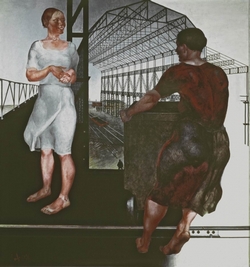 Alexander Deineka is considered by some the father of the Soviet Official art. And yet, his path was not as straightforward as may seem in that respect. Alexander Deineka was born onthe 20th of May 1899, in a family of a railroad worker in Kursk. From an early age he showed a love and aptitude for drawing, which brought him in 1915 to enter Kharkov Art school, where he studied for two years. He was 18 years old when the Great October Revolution shook the country, and the young artist shared enthusiastically the ideas and goals of these changes, as he saw them: the creation of the first egalitarian Proletariat Republic in the world! And he was there, in the first generation of Revolutionary Russia. In 1920 Deineka was sent to study in Moscow VKhUTEMAS, under V.Favorsky, who had great influence over his student, and I.Nivinsky, at the Polygraphic Department, where he studied until 1925. Here he met many of the time's leaders in art, such as V.Mayakovsky.
Together with A.Goncharov and Yu.Pimenov the artist formed the "Group of Three". And in 1925 he became one of the founders of the OST movement, alongside D.Shterenberg, Yu. Pimenov, A.Tyshler, P.Williams and others. In these years he went on many working trips around the country, which inspired his portrayal of the working people, the proletariat and the technological environment of their work, at their routine tasks.
It seems that as his art matured, Deineka was taken with two major themes: one - the specific, idealistic portrayal of the Soviet people, workers and farmers, soldiers and heroism; the other - almost lyrical, the celebration of young vibrant life, sportsmen and sportswomen with pronounced supple and muscled bodies, children in their energetic and youthful innocence. Both these lines have served as the beginning of what was to become the new canons of Official Soviet art, too pronounced and stylized to be totally realistic, a somewhat romantic presentation of these exaggerated robust figures.
When the WWII hit the country, Deineka was once more torn by emotions and fierce pride in the stoicism and heroism of both the Red Army and the Soviet people. This is reflected strongly in his famous "Defence of Sevastopol", "The outskirts of Moscow", "A Village burned Down" and others.
In the last years of his life, Deineka created almost monumental work. In 1956 he created murals for the Opera and Ballet Theatre of Chelyabinsk; made mosaics for Moscow University Assembly Hall. In 1958 he has decorated USSR Pavilion at the International Exhibition in Brussels. In 1961 he participated in decorating the Congress Pallace in Kremlin. The artist died on the 12th of June 1969, in Moscow.
More info
|
|
|
|
|

 The virtual community for English speaking expats and Russians