|
|
|
|
|
|
|
Current 93 (UK)
|
|
|
April 11, 21:00
Sixteen Tons 
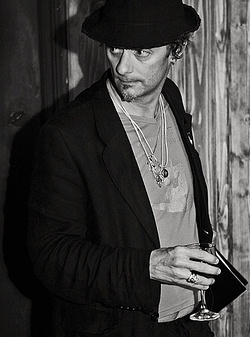 With a glut of industrial-pop hybrids on the market in the 1980s and 1990s, several bands stayed true to the experimental nature of early industrial music. The Psychic TV axis alone spawned many creative artists, including Current 93's David Tibet, who blends Gothic chanting and haunting atmospherics with industrial noisescapes courtesy of tape loops and synthesizers. Though Tibet doesn't quite have bandmates, he frequently works with a core of collaborators including ex-Psychic TV compatriot John Balance (more famous for his work with Peter Christopherson in Coil); Fritz Haaman, formerly of 23 Skidoo (like PTV an offshoot of the most influential of the early industrial acts, Throbbing Gristle); Steven Stapleton of Nurse with Wound fame; Rose McDowall of Strawberry Switchblade; and Hilmar Orn Hilmarsson, also a former member of Psychic TV. Steven Stapleton is probably the most frequent member, appearing on virtually all Current 93 releases - a favor which David Tibet returns by working with Stapleton on most projects by Nurse with Wound.
Named after some theory or other of English mage Aleister Crowley, Current 93's early work used Crowley and Lautreament's Maldoror as the starting points for an occult trip tinged with tragic grandeur. The motto on early albums is "How can there be pleasure, how can there be joy, when the whole world is burning?" On later albums, Tibet finds some joy, though the listener may not, as the music is far less compelling.
The trio of Tibet, Balance, and Haaman debuted in 1983 by recording the single "Lashtah" for Laylah Records. Until the end of the 1980s, Tibet - utilizing the various lineups - recorded at a frenetic pace, issuing more than two albums per year for both Laylah and the Maldoror label. By the 1990s, Tibet's output and style changed slightly: his productivity slowed somewhat, and the sound grew more subdued, encompassing acoustic folk in its most sinister permutations.
Productivity picked up in the 2000s with more Current 93 material being recorded and reissued. Tibet also designed a bottle label for the Absinthe liquor company in 2005. 2006 saw the release of both "Black Ships Ate the Sky" and "Sleep Has His House" on Durtro Records, followed by "Inmost Light" in April 2007.
The record "Aleph at Hallucinatory Mountain" was released in 2009 amid a flurry of other activity including Tibet's art exhibitions and touring. Though it kept its mostly acoustic dreamy feel, Tibet expanded his sonic palette and added some real electric, nightmarish rock on this set. Some of its special guests included guitarist James Blackshaw, Rickie Lee Jones, and Andrew W.K.
With no particular focus beyond a general feeling and Tibet’s vision(s), "Aleph at Hallucinatory Mountain" sticks out like a monolith in Current 93’s canon. Fears that this album would be a disparate work breaking under the weight of Tibet’s many collaborators were completely unfounded. Andrew W.K. and Sasha Grey may be famous for things quite different to Current 93 but they sound as home here as any Current 93 regular. Grey’s detached vocals on “As Real As Rainbows” are a world away from her usual performances and she provides a sober and melancholy ending for such a vivid and energetic album.
The band's latest album, "Baalstorm, Sing Omega" (2010) is no great shift in the Current formula, and as with almost every Current 93 release there's a contradictory and dense sense of the impenetrable and conceptual. If the album can be said to have a single concept then it's to do with Tibet's most famous preoccupation; the apocalypse. Current 93's progression from their post-industrial loops roots, through occultscapes with a heavy Crowley lean and pastoral pentagram/pentecostal folk, has seen them recently arrive at hyper-visual prog-folk-rock preaching. Surprisingly sharp on the heels of "Aleph at Hallucinatory Mountain" and as the final piece of a trilogy, "Baalstorm Sing Omega" sees the band withdrawing from their recent heavier rock-rooted sound. Where the first two-thirds of the trilogy went for the horizon blotting sounds of a bigger, more typical rock aesthetic, the band here are a far gentler collective. Melancholia lies heavy in their hands.
More info
|
|
|
|
|

 The virtual community for English speaking expats and Russians