|
|
|
|
|
|
|
Valentin Serov: Life Line
|
|
|
December 15 - April 08
Tretyakov Art Gallery 
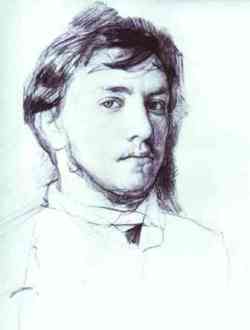 Valentin Serov was born in a family of a famous Russian composer Alexander Serov. In 1871 his father died, and he moved to Munich with his widowed mother, where he took lessons from the artist K. Kepping. Serov studied in Paris, Moscow and St. Petersburg during the period of 1880–1885. His creativity was mainly influenced by the old master paintings he viewed in the museums of Russia and Western Europe, friendships with Mikhail Vrubel and, later, with Konstantin Korovin, and the creative atmosphere of the Abramtsevo Colony, to which he was closely connected.
The greatest works of Serov's early period were mainly portraits: The Girl with Peaches (1887) - please see image on the right, and The Girl Covered by the Sun (1888), both in the Tretyakov Gallery. In these paintings Serov concentrated on spontaneity of perception of the model and nature, in the development of light and color, the complex harmony of reflections, the sense of atmospheric saturation, and the fresh picturesque perception of the world.
From 1890 and on, portrait became the basic genre in Serov's art. It was in this field that his unique style would become apparent, the paintings notable for the psychologically pointed characteristics of his subjects. Having receivied wide popularity, in 1894 Serov joined the Peredvizhniki (The Itinerants), and took on important commissions, among them portraits of grand duke Pavel Alexandrovich, S.M. Botkin, and F.F. Yusupova. Serov consistently used linear-rhythmic drawing coupled with decorative color combinations. He frequently produced intimate, heartfelt, chamber portraits, mainly of children and women. Portraiting children, Serov aspired to capture pose and gesture, to reveal and emphasize a spontaneity of internal movement, sincere cleanliness and clearness of attitude of the child.
The turn of the century saw Serov at a stylistic turning point - features of impressionism disappeared from his work, and his modernistic style developed, but the characteristic truthful and realistic comprehension of the nature of his subjects remained constant. The artist left "Peredvizhniki" and became close to the World of Art group, which allowed him to exhibit his paintings without interruptions even though he never subscribed to all points of the group's program.
Popularity which Serov gained after showing his first two acclaimed portraits made him an artist in great demand. He painted almost 700 canvasses, including portraits of famous art mecenases, artists, actors and actresses, writers and poets, composers and singers, and politicians. Not surprisingly, the names of his sitters read as a who-is-who in Russian culture and politics of the late nineteenth and early twentieth century: Savva Mamontov (1890), Konstantin Korovin (1891), Ilia Repin (1892), Isaak Levitan (1893), Nikolai Leskov (1894), Nikolai Rimskii-Korsakov (1898), Emperor Nicholas II (1900), Konstantin Pobedonostsev (1902), Anton Chekhov (1903), Sergei Witte (1904), Fiodor Shaliapin (1905), Konstantin Balmont (1905), Maksim Gorkii (1905), M.I. Ermolova (1905), Vasilii Golitsyn (1906), E.L. Nobel (1909), Ivan Morozov (1910), O.K. Orlova (1910), Ida Rubinshtein (1910), V.O. Girshman (1911), and many others.
More info
|
|
|
|
|

 The virtual community for English speaking expats and Russians